
After reading this, you’ll understand which types of games are most effective, the key principles at play, and how to use your VR headset to build a stronger core and a more confident stance in the real world.
What is VR posture balance?
VR for posture and balance isn’t a specific genre of app, but rather a powerful side effect of well-designed active experiences. It’s the practice of using immersive games that require dynamic, full-body movements to strengthen the core muscles and retrain the body’s sense of spatial awareness, leading to improved stability and a more natural, upright posture.
This is a significant aspect of the growing field of **VR body health apps**. The connection between a strong core and overall health is well-established. As institutions like Harvard Health emphasize, core strength is fundamental to balance and stability. VR provides a uniquely engaging way to develop this crucial muscle group.
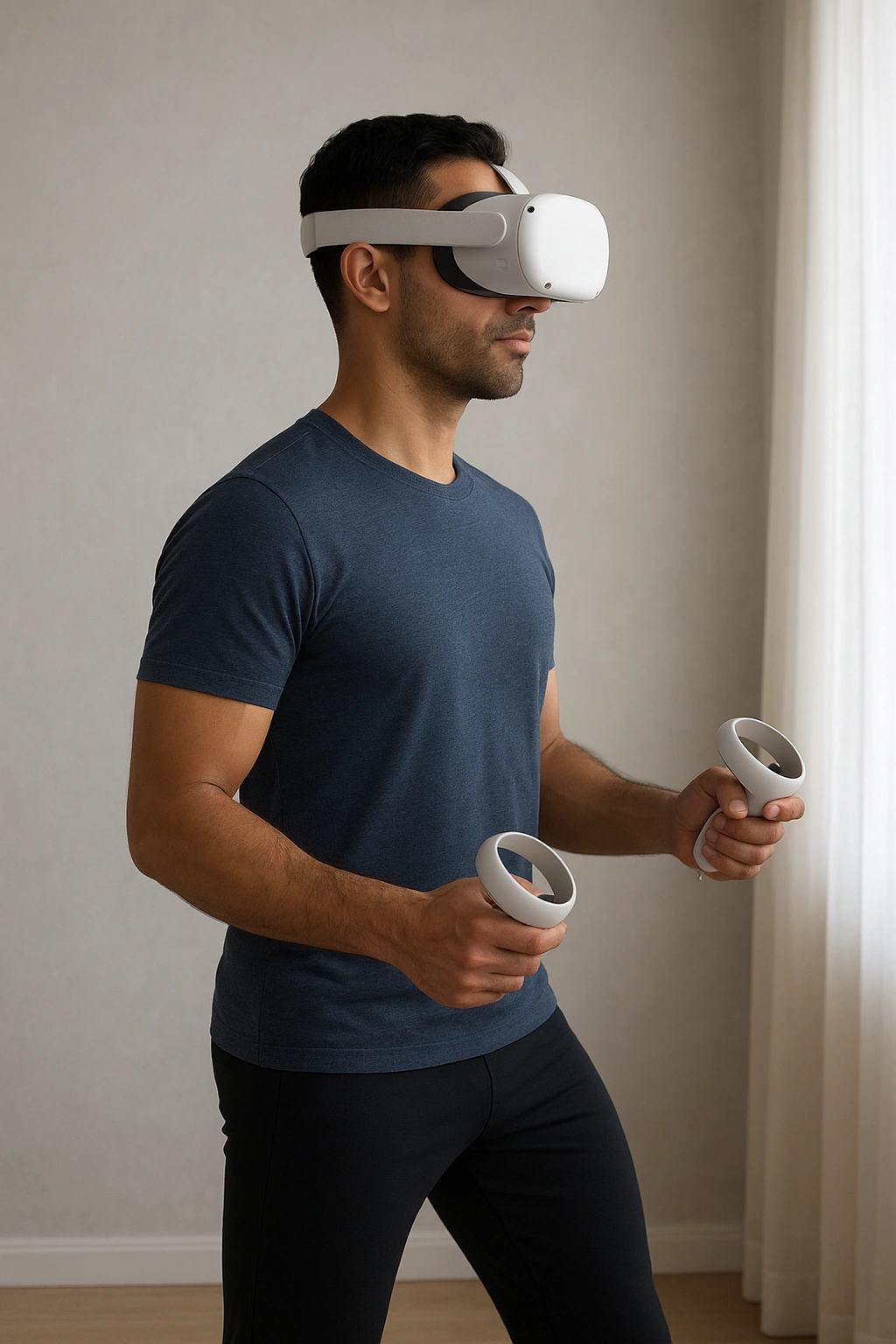
The Core Benefits: How VR Rebuilds Your Foundation
The benefits of using VR for stability go beyond simply standing up straight.
It Forces Constant Core Engagement
This is the primary mechanism. In games where you have to duck, dodge, and weave to avoid oncoming obstacles (like in ‘Pistol Whip’ or ‘Supernatural’), you are constantly performing a dynamic plank. Your abdominal and lower back muscles must fire continuously to keep you stable, turning 30 minutes of gameplay into an incredibly effective core workout.
It Improves Proprioception (Body Awareness)
Proprioception is your body’s innate sense of its position in space. Slouching and sedentary lifestyles can dull this sense. VR forces you to re-engage it. You have to be aware of your body’s position to dodge an obstacle or reach for a target without being able to see your own limbs, effectively retraining your mind-body connection.
It Trains Dynamic, Reactive Balance
Standing on one leg is static balance. Reacting to a sudden, fast-moving object is dynamic balance. VR is a powerful tool for training the latter. It improves your ability to shift your weight and stabilize your body in response to unpredictable stimuli, which is a crucial skill for preventing falls and improving athletic performance. For more on optimizing your performance, see how a virtual assistant can boost productivity.
The Mechanics: How VR Encourages Good Form
VR games naturally guide you into better posture through their design:
- Headset as a Posture Coach: The headset itself encourages you to keep your head up and your spine aligned. If you slouch or crane your neck, your view of the virtual world becomes skewed, naturally prompting you to correct your posture.
- 360-Degree Engagement: Targets and obstacles come from all directions, forcing you to twist and turn from your core rather than just your neck. This builds rotational strength, which is key for a healthy back.
- A Low Center of Gravity: Games with lots of dodging mechanics reward a wide, athletic stance with bent knees. This “power stance” is the foundation of good balance and posture.
Reviewing the Top Apps for Posture and Balance in 2025
1. Pistol Whip
This action-rhythm game is often called “the world’s best squat machine” for a reason. You are constantly dodging, ducking, and weaving through a hail of bullets, forcing you into a low, athletic stance and engaging your core for the entire level.
| Pros for Posture/Balance | Cons for Posture/Balance |
|---|---|
| Forces continuous deep squats and side lunges. | Can be too intense for those with knee issues. |
| Promotes a low center of gravity and core stability. | The focus is on action, not deliberate form. |
Best for: A high-intensity workout that builds incredible leg and core strength.
2. Synth Riders
Unlike games that focus on sharp, rigid movements, Synth Riders encourages fluid, dance-like motion. Following the flowing rails and catching orbs requires you to use your whole body, promoting better posture and a more graceful sense of balance.
| Pros for Posture/Balance | Cons for Posture/Balance |
|---|---|
| Encourages fluid, full-body movement. | Less of a high-intensity core workout than other apps. |
| “Spin” modifiers are an excellent challenge for balance. |
Best for: Improving dynamic balance and body coordination in a fun, flowing way.
3. Guided Tai Chi
This is a dedicated app for mindful movement. You follow an instructor through slow, controlled Tai Chi routines. The entire practice is an exercise in balance, control, and maintaining a strong, centered posture.
| Pros for Posture/Balance | Cons for Posture/Balance |
|---|---|
| Directly trains balance and controlled movement. | Not a high-intensity cardio or strength workout. |
| Excellent for improving mindfulness and body awareness. |
Best for: A direct, low-impact way to train balance and a mindful connection to your posture.
Comparison of VR Apps for Posture & Balance 2025
| App | Primary Benefit | Intensity | Best For |
|---|---|---|---|
| Pistol Whip | Core Strength & Stability | High | A Powerful Core Workout |
| Synth Riders | Dynamic Balance & Coordination | Medium | Fluid, Dance-Like Movement |
| Guided Tai Chi | Static Balance & Body Awareness | Low | Direct, Mindful Practice |

Common Mistakes That Harm Posture in VR
While VR can help, it’s also possible to reinforce bad habits if you’re not careful.
- Craning Your Neck: Don’t just look down with your head; bend at the knees and hips. Keep your spine neutral.
- Only Using Your Arms: In rhythm games, it’s easy to just flick your wrists. Consciously engage your shoulders and core to get the full benefit.
- An Unstable Stance: Don’t stand with your feet locked together. Adopt a wide, athletic stance to create a stable base.
- Using a Poorly Fitted Headset: A front-heavy headset that’s constantly slipping down will encourage you to crane your neck up, reinforcing bad posture. A good head strap is key.
Expert Tips for a Stronger Stance
Ready to stand taller? Follow these expert tips.
- Focus on Your “Power Stance”:
“Before you press start, find your power stance: feet shoulder-width apart, knees slightly bent, core engaged. Try to return to this stable base throughout the game. This is the foundation of all athletic movement,”
says a simulated physical therapist.
- Use a VR Mat: A small, circular mat with tactile bumps helps you stay centered in your play space without looking down, allowing you to focus on your form and balance.
- Start with Slower Speeds: On rhythm games, start with a slower speed to master the movements with good form before you ramp up the intensity.
- Practice Mirroring: Use the passthrough camera to look at your reflection in a window or mirror before you start, checking your posture in the real world.
FAQ – Frequently Asked Questions
Q: Can VR actually fix my bad posture?
A: VR can be a powerful tool to help correct bad posture. By strengthening your core and back muscles and improving your body awareness (proprioception), it helps you naturally hold a better posture in your daily life. However, it works best when combined with conscious effort outside of VR.
Q: What type of VR game is best for improving balance?
A: Games that require dynamic, reactive movement are excellent for balance. This includes rhythm games with dodging mechanics like ‘Pistol Whip’ and ‘Synth Riders,’ as well as dedicated yoga and Tai Chi apps that focus on controlled, stable movements.
Q: Do I need full-body tracking for posture and balance training?
A: No, it’s not necessary. Most of the benefits come from the natural movements required by games that only use a headset and controllers. Your body has to engage its core and legs to stabilize itself, regardless of whether those limbs are being tracked.
Q: Is VR fitness safe for older adults or people with balance issues?
A: It can be, but caution is essential. Low-impact, seated, or slow-moving experiences like Guided Tai Chi can be very beneficial. It’s crucial to start with beginner levels and maintain a clear, safe play space. Consulting with a doctor or physical therapist is recommended.
Q: How does VR improve core strength?
A: Many VR games require you to constantly duck, dodge, twist, and lean to avoid obstacles. These movements force you to engage your abdominal and lower back muscles to stay balanced and stable, effectively turning the entire game into a dynamic core workout.
Conclusion