
Introduction
For decades, the promise of a truly personalized workout was a luxury reserved for those who could afford a personal trainer. Everyone else was left with generic, one-size-fits-all plans. That era is ending thanks to AI VR fitness technology, which combines virtual reality immersion with intelligent guidance. With AI VR fitness technology, workouts become adaptive, responding to your performance and goals in real time. This new AI VR fitness technology is not just another trend; it marks the dawn of intelligent, effective exercise accessible to everyone. By embracing AI VR fitness technology, anyone can experience personalized fitness like never before.
This guide delves into the powerful synergy of AI VR fitness technology and virtual reality. You will learn how AI VR fitness technology works, why it is poised to solve the biggest challenges in personal fitness, and how it can make workouts more engaging and effective. The AI VR fitness technology behind these innovations acts as a smarter, data-driven personal trainer inside your headset. By exploring AI VR fitness technology, you can see how future workouts will be personalized, adaptive, and seamlessly integrated into your daily routine.
What Exactly is AI VR Fitness Technology?
AI VR fitness technology is the integration of artificial intelligence algorithms directly into virtual reality exercise applications. While VR provides the immersive environment (the ‘where’), AI provides the intelligence (the ‘how’ and ‘why’). It transforms a VR game from a simple activity tracker into a dynamic coaching system that sees, understands, and reacts to your every move.
Its relevance in 2025 cannot be overstated. We are moving beyond “gamified fitness,” where points and leaderboards are the main drivers, into the era of “intelligent fitness.” As detailed in reports from tech authorities like Wired, AI is the key to unlocking hyper-personalization at scale. This technology aims to give every user the benefits of an elite one-on-one coach: perfect form, optimized intensity, and a plan that evolves with them.

Why This Fusion is a Fitness Revolution
The combination of AI and VR directly addresses the most common reasons people fail to achieve their fitness goals: poor form, lack of motivation, and workout plateaus.
Injury Prevention Through Real-Time Form Correction
Performing exercises with incorrect form is not only ineffective but also a leading cause of injury. AI acts as a vigilant, virtual spotter that never looks away.
- Computer Vision Analysis: Using the headset’s cameras, the AI tracks your body’s key points to analyze your posture, alignment, and range of motion in real-time.
- Instantaneous Feedback: If your knees cave in during a squat or you’re not rotating your torso enough in a punch, the AI provides immediate visual or auditory cues to help you correct it.
- Safer Workouts: This constant guidance dramatically reduces the risk of strain and injury, making high-intensity exercise safer for people of all skill levels.
True Personalization That Adapts to You
Generic plans don’t account for your daily energy levels, stress, or sleep. An AI-driven workout does.
- Biometric Integration: Future apps will sync with your smartwatch or other wearables. The AI will know if you’re fatigued and can adjust the workout’s intensity accordingly.
- Performance-Based Progression: The AI learns your strengths and weaknesses. It can generate workouts that specifically target areas for improvement, ensuring you never plateau.
- Goal-Oriented Planning: Whether you want to improve cardio, build strength, or increase flexibility, the AI can design a long-term, progressive plan tailored to those specific outcomes.
Enhanced Motivation and Engagement
AI enhances the gamification of VR fitness by making it more meaningful. Your progress isn’t just a higher score; it’s a tangible improvement in your form, power, or endurance, which the AI can highlight to keep you motivated. For help scheduling these advanced workouts, a Virtual Assistant Biz ID can streamline your calendar.
How AI VR Fitness Technology Works
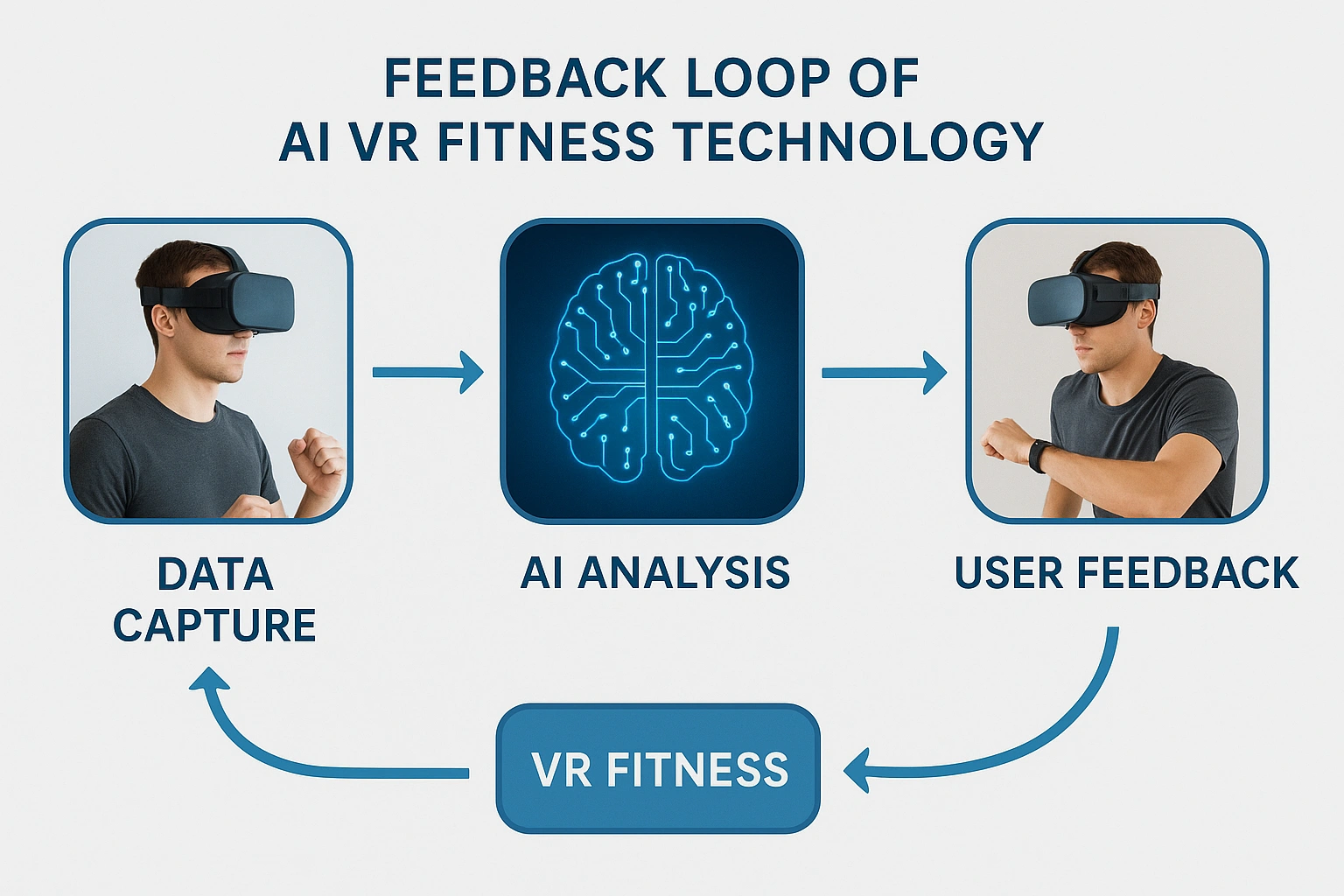
The process can be broken down into a simple feedback loop:
- Data Capture: The headset’s built-in cameras capture your movements. Sensors in the controllers track the speed and trajectory of your hands.
- AI Analysis: On-device or cloud-based AI models process this data in milliseconds. Using computer vision, it creates a skeletal model of your body and compares it to a database of ideal exercise forms.
- Actionable Feedback: The AI generates real-time feedback. This could be a visual overlay showing the correct angle for your arm, a haptic buzz in the controller when you hit a target perfectly, or a verbal cue from your virtual coach.
- Learning and Adaptation: The results of your performance are fed back into the system, allowing the AI to adjust the next set of exercises or the entire workout plan for your next session.
Use Case: The AI-Powered Boxing Coach
Imagine a future version of a boxing app like Thrill of the Fight integrated with advanced AI.
Experience: You step into the virtual ring. Your AI coach, voiced by a legendary trainer, starts the session. As you throw punches, it doesn’t just register hits. It analyzes your guard, the rotation of your hips, and the extension of your arm. “Tuck your chin!” it advises. “Rotate your back foot more for power on your cross!” A ghosted image overlays your own, showing you the perfect form. Between rounds, it shows you data on your punch speed and accuracy, suggesting a drill to improve your jab.
| Pros of an AI Coach | Cons of an AI Coach |
|---|---|
| 24/7 access to expert-level feedback | Lacks human intuition and motivational nuance |
| Completely data-driven and objective | May struggle with unconventional body types |
| Affordable and scalable coaching | Dependent on the quality of its programming |
Challenges and Ethical Considerations
This powerful technology also comes with challenges that the industry must address:
- Data Privacy: The intimate nature of biometric and movement data requires robust security and transparent privacy policies.
- Algorithmic Bias: AI models must be trained on diverse datasets to ensure they work effectively for people of all body shapes, sizes, and abilities.
- Over-reliance on Tech: Users must be encouraged to listen to their bodies, not just the AI, to avoid injury and burnout.
- The Human Element: While AI is a powerful tool, the motivational and psychological support of human coaches and community remains invaluable.
How to Embrace the AI Fitness Future
As these apps become available, here’s how to make the most of them:
- Look for Transparency: Choose apps that are clear about how their AI works and what data they collect.
- Perform the Calibration: Take the time to properly complete any initial setup or calibration routines so the AI can build an accurate profile of you.
- Trust but Verify: Use the AI’s feedback as a guide, but always pay attention to how your body feels. Technology is a tool, not a replacement for self-awareness.
- Stay Updated: The AI models will constantly be improved. Keep your apps updated to benefit from the latest advancements.
“AI VR fitness technology is the democratization of elite personal training. For the first time, millions of people will have access to real-time, personalized feedback that can fundamentally improve their health outcomes,” says tech analyst Dr. Evelyn Reed.
FAQ (Frequently Asked Questions)
Answering key questions about the new wave of **AI VR fitness technology**.
Q: How does an AI ‘see’ my workout form in VR?
A: AI uses computer vision to process the video feed from your headset’s cameras. It identifies your body’s key joints and limbs to create a real-time skeletal model, which it then compares against ideal exercise forms to provide feedback.
Q: Is my personal fitness data safe with these AI apps?
A: Reputable developers prioritize user privacy. They typically process movement data on-device or use anonymized data for their AI models. Always review the privacy policy of any fitness app before use.
Q: Will AI make VR fitness apps more expensive?
A: Initially, apps with advanced AI features might be positioned as premium subscription services. However, as the technology becomes more widespread, AI-powered features are expected to become a standard offering in competitive fitness apps.
Q: Can AI VR fitness replace a human personal trainer?
A: While AI can provide excellent, data-driven feedback on form and performance, it can’t replace the holistic motivation, accountability, and nuanced understanding of a human trainer. It’s best viewed as a powerful tool to supplement and democratize fitness coaching.
Q: What is the difference between a ‘smart’ workout and an ‘AI’ workout?
A: A ‘smart’ workout might pre-program a routine based on your stated goals. An ‘AI’ workout is dynamic; it actively learns from your performance during the session and adjusts intensity, exercises, and feedback in real-time.
Conclusion
The convergence of AI and VR is not a distant fantasy; it’s the next logical step in the evolution of personal health. AI VR fitness technology promises to make workouts safer, more effective, and deeply personalized. With AI VR fitness technology, your virtual workouts can adapt in real time to your performance and needs. The AI VR fitness technology of 2025 will go beyond simple games, acting as a true partner in your wellness journey. By embracing AI VR fitness technology, exercise becomes smarter, more engaging, and tailored just for you.
As we look toward the AI VR fitness technology, it’s clear that intelligence and immersion are the keys to unlocking human potential. The era of generic fitness is over. The era of intelligent fitness is just beginning. For more on the intersection of AI and daily life, check out resources from TechCrunch.
Are you excited or skeptical about having an AI as your personal trainer? Let us know in the comments!